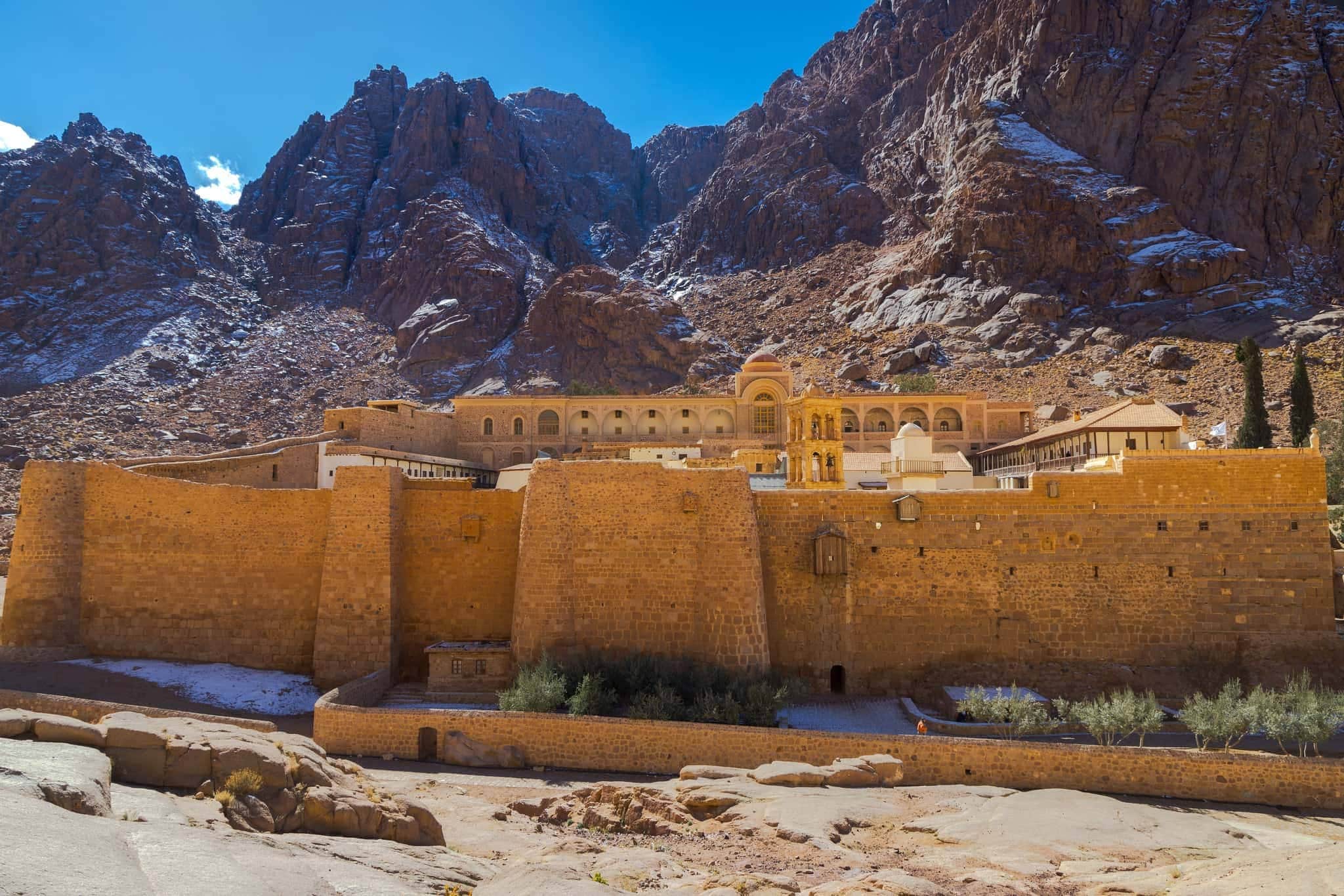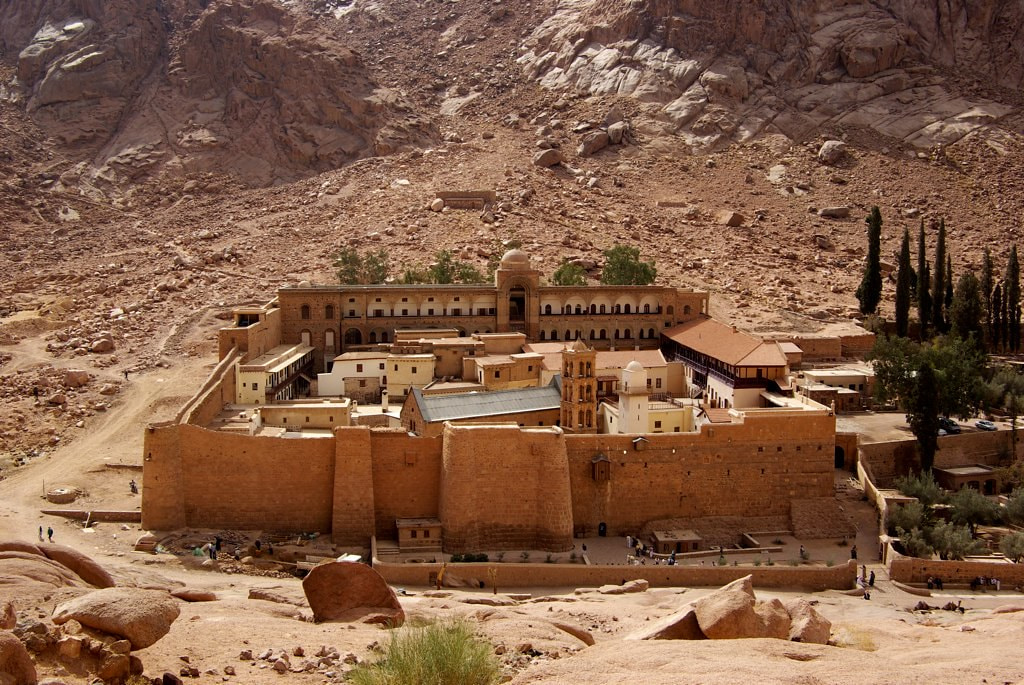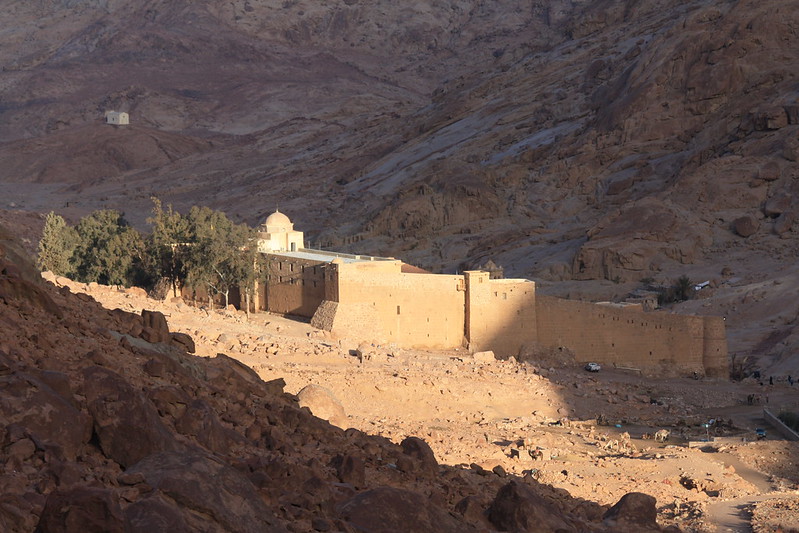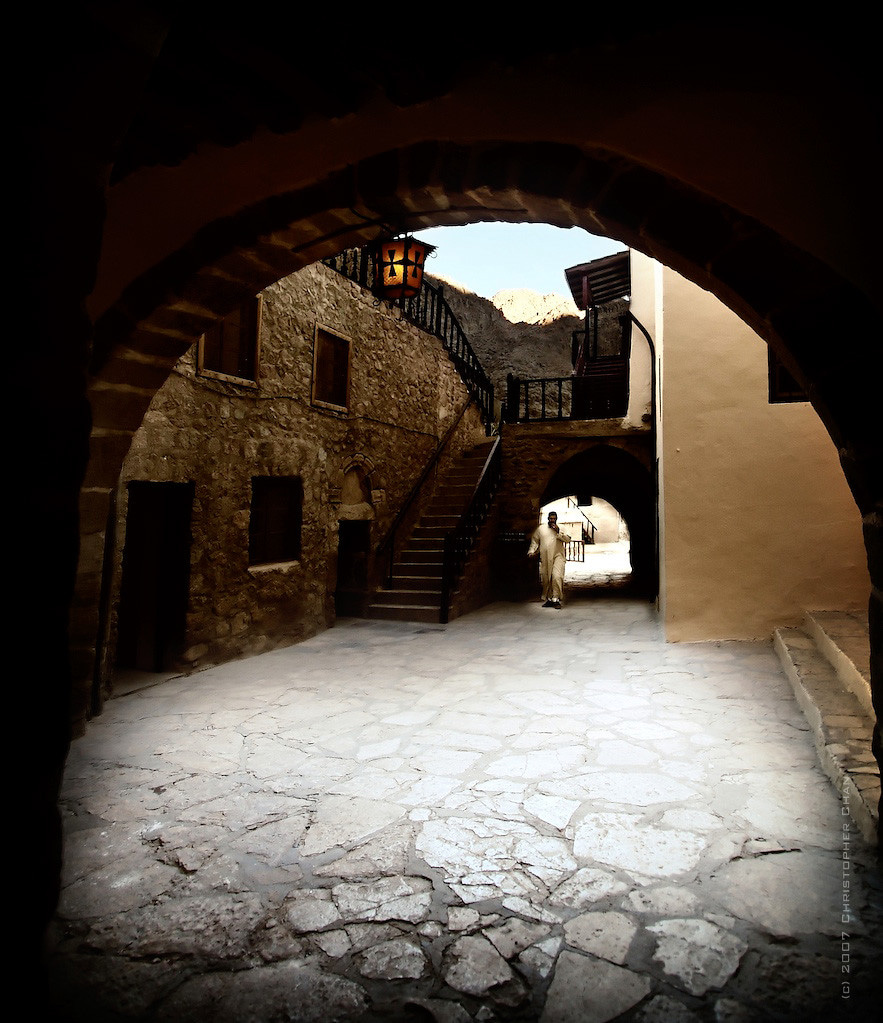
In the heart of the mountainous desert of the Sinai Peninsula, where time seems to stand still and history blends with legend, stands Saint Catherine’s Monastery. More than just a religious enclave, this millennial fortress is a living symbol of coexistence, an unparalleled repository of knowledge, and a tangible bridge between cultures and creeds. Founded in the 6th century by order of Emperor Justinian I, this Byzantine complex not only holds the title of being one of the oldest continuously operating Christian monasteries in the world but also stands as a guardian of one of humanity’s most valuable bibliographic collections. Its majestic and sober presence, at the foot of Mount Sinai, distinguishes it from any other wonder of Egypt.
Far from the pyramids and temples of the Nile, the historical and spiritual importance of Saint Catherine’s Monastery rivals that of ancient Egypt’s most iconic monuments. For centuries, it has been a beacon of wisdom and tolerance, attracting pilgrims, scholars, and curious visitors from all corners of the globe. Its geographical isolation has been, paradoxically, its greatest protector, safeguarding a legacy that few places on Earth can match. It is a destination for those seeking a Sinai pilgrimage that transcends mere tourism, an immersion into the profound history of Christianity.
The Library: A Treasure Trove of Manuscripts Whispering the Past
The true pulsating heart of the monastery is its ancient library Egypt, one of the most venerable and rich in the world. With over 6,000 manuscripts in languages as diverse as Greek, Arabic, Coptic, Syriac, Georgian, and Church Slavonic, this space is an invaluable window into the history of thought and faith. Among its most precious jewels is the Codex Sinaiticus, a 4th-century manuscript containing the oldest known and almost complete version of the Bible in Greek. Discovered in the 19th century by scholar Constantin von Tischendorf, this codex is considered one of the most important finds in biblical paleography, a fundamental piece for understanding the scriptures.
Furthermore, the library houses a remarkable collection of palimpsests, manuscripts where the original text was erased to reuse the valuable parchment. Thanks to advanced multispectral imaging techniques, researchers have managed to reveal the underlying writings, discovering texts believed to be lost, including works in extinct languages such as Caucasian Albanian and Christian Palestinian Aramaic. This recovery work highlights the monastery’s dedication to the preservation of knowledge and its role as a UNESCO World Heritage site. For lovers of ancient manuscripts, this library is an intellectual paradise, even if not open to the general public.
A Sanctuary of Coexistence and Spirituality
Beyond its manuscripts, Saint Catherine’s Monastery represents religious tourism Egypt that symbolizes interfaith harmony. A lesser-known fact that underscores this spirit of interfaith coexistence is the presence of a small Fatimid mosque, built in the 11th century, within its walls. This unique feature is a testament to the peaceful coexistence and mutual respect that has prevailed in the region throughout the centuries, despite external political tensions.
For the traveler, visiting this Saint Catherine’s Monastery is an unparalleled experience. It is recommended to plan the visit during the spring (March to May) or autumn (September to November) months when temperatures are more pleasant. Ascending Mount Sinai to witness the sunrise, a millennial tradition, offers a breathtaking spiritual and visual experience, complementing the monastery visit. It is a combination of adventure tourism and reflection that few places can offer.
Saint Catherine’s Monastery is, in essence, a beacon of resilience and spirituality. A place where every stone, every manuscript, and every story whispers the richness of humanity and the profound connection between faith, knowledge, and coexistence. A journey to this sacred corner of Sinai is an invitation to explore not only a UNESCO World Heritage site but also the boundaries of history and faith.