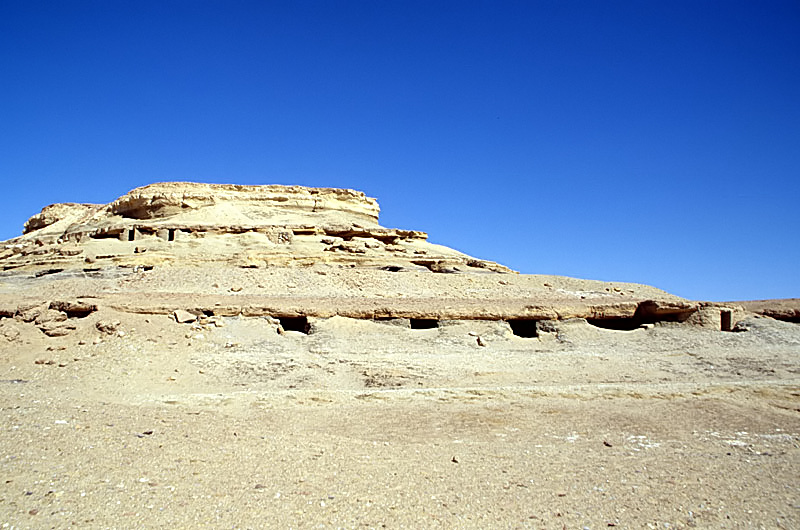
Far from the familiar pulse of the Nile, where the sands of Egypt’s Western Desert begin to whisper ancient tales, lies the Dakhla Oasis, a haven of green life suspended in time. Yet even within this secluded refuge, deeper secrets await the curious traveler. One of the most captivating is Qarat al-Muzawwaqa, the “Decorated Hill,” a name that only hints at the artistic marvel it shelters. Picture an ancient cemetery, largely absent from standard guidebooks, a silent, history-laden place tucked away in a remote corner of the oasis. Its surroundings, dotted with subtle ruins, seem to guard forgotten legends, beckoning the intrepid visitor to listen for their echoes on the desert wind.
This site is not a Pharaonic necropolis of monumental grandeur, but something perhaps more subtle and revealing: a final resting place that flourished during Egypt’s Roman era, roughly between the 1st and 4th centuries AD. In those times, Dakhla was a vital enclave, an agricultural hub, and a point along the routes crossing the vast sea of sand. Here, at Qarat al-Muzawwaqa, the inhabitants of the area found their eternal rest, likely including members of the local elite who wished to secure their journey into the afterlife with a touch of earthly distinction.
What sets this necropolis apart is not its scale, but the intimate and vibrant art adorning the walls of its most notable tombs, primarily those of Petosiris and Petubastis. Built of mudbrick and hidden beneath the sand for centuries, these burial chambers reveal an astonishing visual spectacle: frescoes that narrate a captivating dialogue between two civilizations. Here, the traditional Egyptian pantheon comes alive with unexpected flair. Anubis, the guide of souls, oversees mummification; Osiris presides over his underworld realm. However, these ancestral figures share space with unequivocally Greco-Roman elements. The zodiac unfolds its celestial signs across the ceiling, grape-laden vines climb the walls, and figures are depicted in classical togas as well as Pharaonic attire. It’s a fascinating syncretism, a fusion where rigid Egyptian artistic conventions relax to embrace a naturalism and perspective influenced by Rome, creating a unique visual language.
Visiting Qarat al-Muzawwaqa is an experience that contrasts sharply with the bustling sites along the Nile. The silence is profound, broken only by the whisper of the wind across the hill. The sense of discovery is genuine, standing before these vivid and singular paintings, knowing that few eyes outside of archaeology behold them. It’s a direct encounter with history, with the beliefs and identity of people who lived and died at this cultural crossroads nearly two millennia ago.
For the traveler seeking to veer off the beaten path, who yearns for authentic connection over predictable comfort, Qarat al-Muzawwaqa offers an invaluable reward. It’s not just a destination, but an immersion into a lesser-told chapter of Egyptian history – an eloquent testament to how cultures can meet, blend, and create something entirely new and beautiful, even in the most remote desert confines.